
Thanks to the pharmaceutical industry, most of us are familiar with the concept of time-release capsules. Our tummies ache and we soothe them – not with a concentrated blast of raw medicine, but with a pill that gently releases its ingredients through the day.
Now picture a 13-mile-wide time-release capsule floating in the Weddell Sea – that nook of water that hides out in the lee of the Antarctic Peninsula. That’s the picture that Ken Smith, of the Monterey Bay Aquarium Research Institute, and his colleagues offered this week in Science Express.
Smith and his team studied a couple of large icebergs as they drifted away from the Frozen Continent. Granted, it doesn’t take eight scientists and an NSF grant to realize that icebergs melt in water. But what Smith found interesting was all the dirt sprinkled throughout the ice. While dirt is pretty unremarkable on land, it gets increasingly rare and precious as you head out to sea. The minerals and nutrients it contains are simply missing from large swaths of ocean water. In this respect, an iceberg is sort of like a humongous Jolly Rancher candy drifting through the sea, slowly distributing its goods.
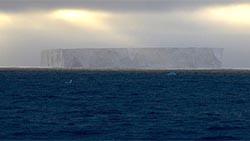 Smith’s study measured the effect of the added nutrients – evident to more than 2 miles away – and traced them up the food chain. They found more phytoplankton, more krill and more seabirds around their icebergs than in open water. In 4,300 square miles of the Weddell Sea, they counted a thousand more icebergs and calculated they could be spurring productivity in as much as 39% of the Weddell’s waters. When all that fertilization is combined, they suggest, it could have a significant contribution to drawing carbon dioxide out of the atmosphere and sequestering it in the ocean.
Sound familiar? This is a neat illustration of a nearly self-contained ecosystem, the kind of microcosm – like a termite mound, or a tree frog living in a bromeliad plant – that never fails to capture our imagination. That’s why I like the story. And yet, didn’t Science just report something far less optimistic about fertilizing ocean waters and carbon dioxide? Yes, not two months ago, in fact, we learned that most of that carbon – 50% to 80% of it – gets recycled by zooplankton and never makes it to the safety of deep waters.
I suppose it’s hard to blame Smith et al. for not fleshing out their argument. They are, after all, writing in Science, which is so tight on space that it no longer bothers printing study methods (relegating them instead to “supporting online material”). But then, if academia has become so compartmentalized, is it fair to turn around and blame journalists for misrepresenting the broader issue? Their word counts are even stingier (and their syllable counts? forget it).
Science Express, where Smith’s article appeared, is the online-only, rush-publication branch of Science that its editors reserve for the coolest, latest-breaking research. This same week, Science ran two articles about carbon sinks – basically, the question of where all the carbon that doesn’t stay in our atmosphere winds up. One reported that tropical forests do more carbon uptake and northern forests less than we previously thought. The other suggests changing wind patterns in the Southern Ocean have reduced its capacity for soaking up carbon over the last 25 years.
To help Science‘s readership keep all this research straight, David Baker, of the National Center for Atmospheric Research, offered a “Perspective” article summarizing the two papers. But even here, the scope was reined in. The editorial didn’t mention Smith’s article, even though the same publisher ran it the very same week and it broached the very same topic: carbon dioxide uptake in the Southern Ocean
For academia, this is appropriate. Smith and co. didn’t offer any actual data about carbon sequestration, so it’s premature for scientists to talk about it. And yet, which of these various papers should a reporter draw from? As long as scientists drop nuggets of research haphazardly into the literature, we have to expect it to diffuse on its own, slowly and gently, into the ocean of public awareness. So far, climate change seems to have taken some 50 years to acheive an effective dose.
Illustration: Nicolle Rager Fuller, National Science Foundation; photo: Rob Sherlock, MBARI.




 surf.bird.scribble.
The world never ceases to amaze me. Thanks for the info — and for the links. (While the “About” note is ne doubt true for many, I have always considered oceanograpy a “big-ticket item”!)
idrmf ehwmubp mnoeyzx
zhucj fceg
iexhzc ihcejq